


Your mobile bill may go down, but some wireless stocks may not like it.
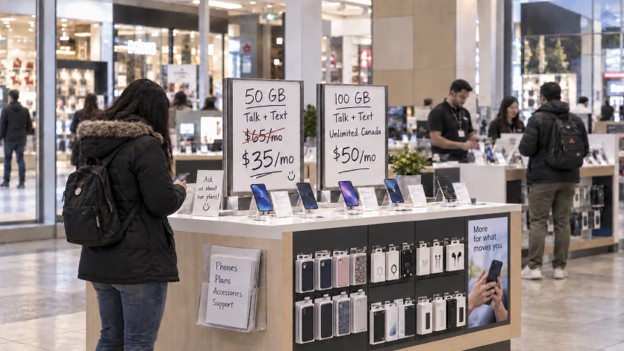
For years, Canada’s wireless industry looked less like a battleground than acomfortable club. Three national carriers controlled 90% of the national market1,and mobile bills were among the richest in the developed world, and consumershad relatively few places to go.
That cosy arrangement is starting to crack.
The catalyst is Quebecor, owner of Freedom Mobile, Fizz and Videotron. Since acquiring Freedom in 2023, Quebecor has pushed beyond its Quebec base with a straightforward proposition: offer substantially cheaper plans, strip out much of the traditional retail and customer-service overhead, and make online user experience fun. Its Fizz brand captures that strategy neatly with a digital-first, self-service carrier whose prices often undercut rivals by 30%or more.
So far, the model appears to be working.
In the second quarter of 2026, Quebecor’s mobile service revenue rose 9.2% year over year, driven by growth in both subscribers and per-user revenue. And both gross and net profit margins expanded. That is an important combination. Quebecor is not merely throwing discounts at the market and buying customers at any cost; it is growing quickly while preserving healthy economics.
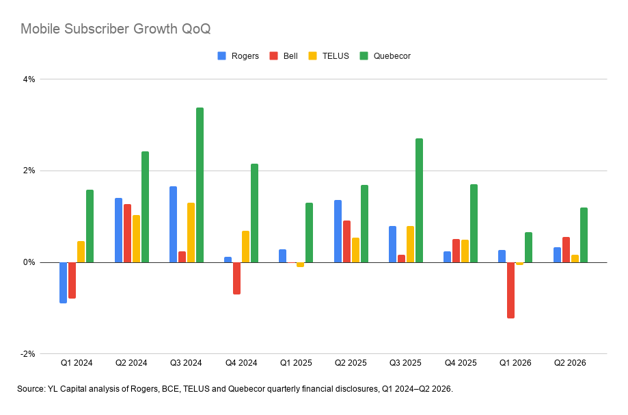
The incumbents are beginning to feel the squeeze. While the three largest carriers still dominate industry revenue, new entrants accounted for more than 55% of mobile subscriber additions in 2024—a trend evident across the Maritimes, western Canada, Quebec and Ontario—according to an industry report published by Canada’s telecom regulator in February 20262. That matters because telecom competition rarely starts with a spectacular collapse in market share. It usually begins with something quieter: lower pricing, more promotions, customers migrating to cheaper brands, and margins being chipped away quarter by quarter.
And Quebecor is unlikely to declare victory and go home anytime soon. As part of its Freedom acquisition, the company committed to keeping comparable Freedom plans at least 20% cheaper than incumbent benchmarks for ten years, effectively extending the price fight toward 2033. It also owns meaningful spectrum and infrastructure while using roaming, network-sharing and wholesale access to broaden coverage efficiently.
For consumers, this is excellent news. Mobile bills have room to fall.
For investors, price wars may be less cheerful, depending on their exposure to wireless stocks.
The most vulnerable companies are likely to share a recognizable profile: premium pricing supported by expensive retail, sales and customer-service networks; high financial leverage; limited ability to differentiate through bundled content or other services; and valuations that assume today’s margins will persist.
These businesses are caught between a rock and a hard place. Cut staff, stores and service costs too aggressively, and the customer experience may deteriorate—undermining the premium pricing they are trying to defend. Keep the cost structure intact, and a digital-first challenger can keep undercutting them.
The old leaders still have formidable advantages: scale, spectrum, established networks and strong brands. But the rules of the game are changing.
Canadian consumers may finally have something to celebrate on their monthly phone bills. Investors, however, should pay close attention to which carriers can live with lower prices—and which ones cannot.
1, 2. CRTC, Canadian TelecommunicationsMarket Report 2026 (published February 2026).
This article is published by YL Capital Ltd.("YLC"), registered with the British Columbia Securities Commission as an Investment Fund Manager, Portfolio Manager, and Exempt Market Dealer, for general informational purposes only. It reflects the views of the author as of the date of publication and describes general market conditions and asset-classconsiderations. Nothing in this article constitutes investment advice or arecommendation to buy, sell, or hold any security, or to adopt any particular asset allocation, and it does not take into account the investment objectives,financial situation, or particular needs of any individual reader. Statements about future outcomes are opinions and are not guarantees of future results. Readers should consult their own advisor before making any investment decision.