

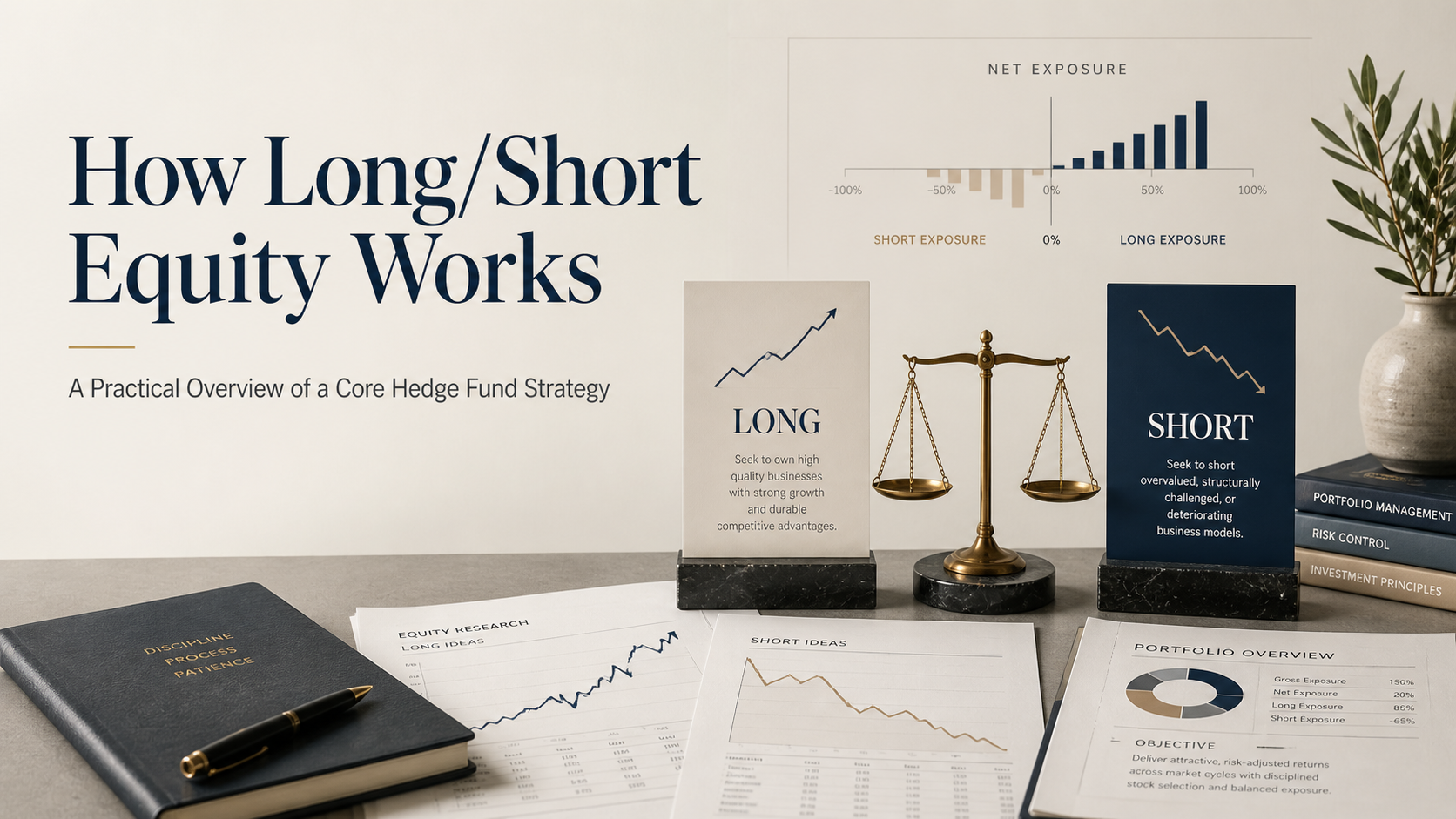
Long/short equity is one of the oldest and most widely used hedge fund strategies in the world. It is also one of the most misunderstood.
At its core, the idea is simple: buy stocks you believe will go up, and sell short stocks you believe will go down. By combining long and short positions in a single portfolio, the manager can generate returns from stock selection while reducing dependence on the overall direction of the market.
This article explains how long/short equity actually works, why investors allocate to it, and what separates a good long/short manager from a bad one.
The Basic Mechanics
A traditional equity investor — a mutual fund, for example — can only make money when stock prices rise. They buy shares, hold them, and hope the market cooperates. If the market falls 20%, a portfolio of good stocks can still lose 15%. The manager may have picked well, but the investor still lost money.
A long/short equity manager operates differently. They hold two types of positions at the same time:
Long positions are stocks the manager expects to increase in value. This is the familiar part — you buy shares because you believe they are undervalued or have strong growth prospects.
Short positions are stocks the manager expects to decrease in value. To sell short, the manager borrows shares and sells them in the market, with the intention of buying them back later at a lower price. The difference between the selling price and the buying price is the profit.
By holding both long and short positions, the portfolio is partially hedged against broad market moves. If the market drops 10%, the long positions may lose value, but the short positions should gain value, offsetting some or all of the loss.
The manager's return comes from the spread between the performance of their long and short books — not from the market going up or down. This is the fundamental advantage of the strategy.
Net Exposure: The Dial That Controls Market Risk
The balance between long and short positions determines how sensitive the portfolio is to market direction. This is measured by net exposure.
Net exposure is calculated as: long exposure minus short exposure.
For example, if a portfolio is 80% long and 40% short, the net exposure is 40%. This means the portfolio behaves roughly like a portfolio that is 40% invested in the stock market. If the market rises 10%, the portfolio might gain about 4% from market direction alone — plus or minus the returns from individual stock selection.
Different managers run very different levels of net exposure depending on their style and market view:
Low net exposure (0–30%). The manager is making a minimal bet on market direction. Returns come almost entirely from picking the right longs and shorts. This approach has lower volatility but requires very strong stock selection skill.
Moderate net exposure (30–60%). The most common range. The manager maintains some positive market exposure — a structural view that equities tend to go up over time — while still using shorts to dampen risk and generate additional returns.
Variable net exposure. Some managers actively adjust their net exposure based on their assessment of market conditions. They might run 70% net when they are bullish and 10% net when they see elevated risk. This adds a macro timing element to the stock selection process.
The ability to adjust net exposure is one of the key advantages of long/short equity over long-only investing. A traditional manager has one dial: which stocks to own. A long/short manager has two: which stocks to own, and how much market risk to take.
Where Returns Come From
Long/short equity returns can be broken into three components:
Alpha from long positions. This is the return from picking stocks that outperform the market. If the market returns 8% and your long book returns 12%, that 4% outperformance is alpha.
Alpha from short positions. This is the return from identifying stocks that underperform. If the market returns 8% and your short book returns 3%, the underperformance of the shorts generates a return for the portfolio. Good short selling is genuinely difficult — stocks have a natural upward drift, and short positions have unlimited theoretical downside — which is why the quality of the short book often separates great managers from average ones.
Market exposure return (beta). Whatever net exposure the manager carries, they will capture a proportional share of the market's return. A manager with 40% net exposure in a market that returns 10% captures about 4% from beta alone.
The best long/short managers generate meaningful alpha from both sides — their longs outperform and their shorts underperform relative to the market. This is referred to as generating alpha on both legs, and it is the hallmark of a skilled practitioner.
The Role of Short Selling
Short selling is what makes long/short equity fundamentally different from traditional investing. It serves three purposes:
Hedging. Short positions reduce the portfolio's sensitivity to market declines. In a bear market, profits from shorts can offset losses on longs, protecting capital.
Return generation. A well-researched short position generates returns when the stock declines. This creates an additional source of profit that is not available to long-only investors.
Capital efficiency. The proceeds from short sales can be used to fund additional long positions. A manager who is 100% long and 50% short effectively has 150% of their capital deployed in investment ideas, while maintaining only 50% net market exposure.
Short selling is also where much of the risk lies. A long position can only go to zero — you lose your investment. A short position can theoretically go to infinity — if the stock doubles, triples, or keeps rising, the losses compound. This is why position sizing and stop-losses on short positions are critical.
The best short sellers are not simply betting against companies they dislike. They are identifying specific catalysts that will cause the market to re-evaluate a stock downward: deteriorating fundamentals, unsustainable valuations, accounting irregularities, or structural industry headwinds.
Who Allocates to Long/Short Equity and Why
Long/short equity is the largest single strategy category in the hedge fund industry globally. The strategy attracts capital from a wide range of investors:
Pension funds and endowments allocate to long/short equity as a way to maintain equity market exposure while reducing overall portfolio volatility. By replacing some of their long-only equity allocation with a long/short strategy, they can achieve a similar long-term return with fewer large drawdowns.
Family offices and high-net-worth individuals often use long/short equity as their primary equity allocation. For investors who have already accumulated significant wealth, protecting that wealth from a major market decline is often more important than maximizing upside in a bull market.
Fund of funds and allocators use long/short equity as a core building block in multi-strategy portfolios, combining it with other strategies like global macro, credit, and quantitative to create diversified hedge fund exposure.
The common thread is that these investors want equity returns but do not want full equity risk. Long/short equity offers a middle ground: participation in equity markets with a degree of downside protection that long-only investing cannot provide.
What Makes a Good Long/Short Manager
Not all long/short equity managers are created equal. The strategy requires a specific combination of skills:
Stock selection on both sides. It is relatively common to find managers who are good at picking longs. It is much rarer to find managers who are also good at picking shorts. The short side requires a different analytical framework — you are looking for things that are wrong, not things that are right — and a different temperament.
Risk management discipline. A long/short manager who does not manage position sizes, stop-losses, and portfolio exposure carefully can still lose significant capital, even with shorts in the portfolio. The hedging only works if it is actively maintained.
Adaptability. Market regimes change. A manager who ran a successful long/short book during a low-correlation, stock-picker's market may struggle in an environment driven by macro factors and high correlation. The best managers adjust their process and exposure to match the environment.
Transparency. Investors should be able to understand what a long/short manager owns, why they own it, and what the major risk exposures are. A manager who cannot clearly explain their portfolio is either running a strategy they do not fully understand or is not willing to be held accountable for their decisions.
Long/Short Equity vs. Market Neutral
One common source of confusion is the difference between long/short equity and market neutral strategies.
A market neutral strategy targets zero net exposure — the long and short sides are balanced so that the portfolio has no sensitivity to market direction. Returns come entirely from stock selection.
Long/short equity, by contrast, typically maintains some positive net exposure. The manager believes they can add value through stock selection AND wants some participation in the long-term upward trend of equity markets.
Market neutral strategies tend to have lower volatility and lower returns. Long/short equity strategies tend to have moderate volatility and higher return potential. The right choice depends on the investor's objectives and risk tolerance.
How YL Capital Uses Long/Short Equity
Long/short equity is our flagship strategy at YL Capital. We integrate fundamental equity research with active long and short positioning, complemented by tactical use of liquid futures markets.
Our approach is built on three principles. First, every position — long or short — has a clearly defined thesis and a predetermined exit plan. Second, net exposure is actively managed based on our assessment of market conditions, not fixed at a static level. Third, risk management is embedded in every step — from position sizing to stop-loss execution to portfolio-level drawdown limits.
The goal is to generate returns from research and analysis, not from market direction. In a rising market, we expect to capture a portion of the upside. In a falling market, we expect our short positions and reduced exposure to protect capital. Over a full cycle, this approach aims to deliver attractive risk-adjusted returns with significantly lower drawdowns than a traditional long-only equity portfolio.
YL Capital is an independent investment management firm based in Vancouver, Canada. For more information about our long/short equity strategy, visit ylcapital.ca or contact us at info@ylcapital.ca.
Views expressed are those of the author as of the date of publication and do not constitute investment advice. Past performance is not indicative of future results. Investing involves risk, including the possible loss of principal.