



Traditional measures of market sentiment are flashing red, yet tech giants keep beating expectations. Making sense of that paradox is the central task in portfolio construction today.
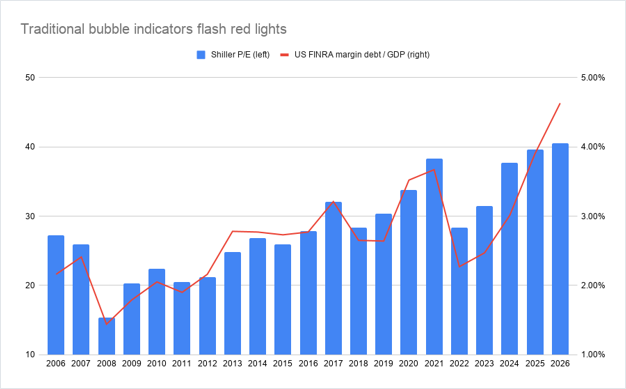
The warning lights are not subtle. The Shiller CAPE ratio, a classic measure of stock-market valuation, sits above 40, close to its 1999–2000 extreme, and US margin debt hits a record 4.6% of nominal GDP. Positioning tells the same story: fund manager cash is low enough to trigger the Bank of America’s contrarian sell signal, while retail cash allocation drops well below its long-run average.
Source: Shiller, FINRA, BEA
Each measure has known flaws. But when valuation, leverage and cash levels all point the same way, the aggregate signal is hard to ignore. What they tell us reliably is that the market has little margin for disappointment. What they cannot reveal, though, is when that disappointment will come.
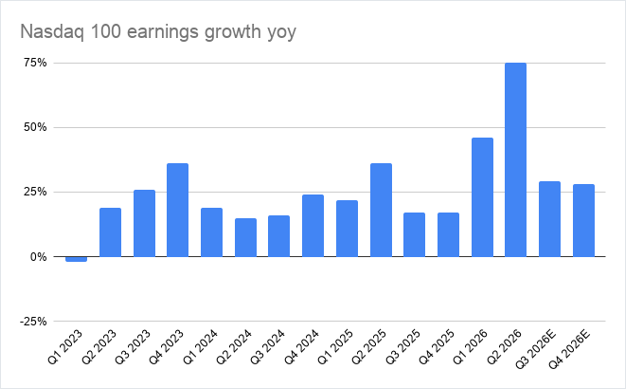
The strongest argument against an imminent crash is that the earnings boom is real. Of the Nasdaq 100 companies that have reported in the second quarter, more than 80% beat EPS estimates, with an aggregate underlying growth of ~30% (excluding huge investment gains at Alphabet and Amazon).
Source: Nasdaq, Factset
Beneath the headline is a real investment boom — hyperscaler capex flowing into AI infrastructure, semiconductors, data centres and power. Alongside the boom, however, there is a weaker economy of households, housing and smaller businesses.
The catch is that the AI boom simultaneously lowers the probability of an immediate crash and raises the severity of an eventual one. If AI demand keeps compounding, today’s high multiples can be worked off through earnings rather than price. But if investors see an overbuild and hyperscalers start talking about “capex discipline”, estimates and multiples will fall together.
We therefore watch the second derivative of AI growth rather than just revenue, looking out for signs of capex guidance slowing, cloud backlogs easing, earnings revisions turning negative, or widening credit spreads. A few of these combined would alarm us more than another record CAPE reading.
Our conclusion is not to sell everything. Valuation extremes are not the most reliable timing tools, and exiting a bubble too early often proves to be an expensive discipline. We should instead minimize or avoid leverage, which can turn a drawdown into a forced sale at the worst possible price. It’s time to demand wider margins of safety and keep genuine liquidity, so that a sharp fall becomes an opportunity rather than a problem. And we may diversify our assets through a measured allocation to treasuries, commodities and currencies alongside equities.
This article is published by YL Capital Ltd.("YLC"), registered with the British Columbia Securities Commission as an Investment Fund Manager, Portfolio Manager, and Exempt Market Dealer, for general informational purposes only. It reflects the views of the author as of the date of publication and describes general market conditions and asset-classconsiderations. Nothing in this article constitutes investment advice or arecommendation to buy, sell, or hold any security, or to adopt any particular asset allocation, and it does not take into account the investment objectives,financial situation, or particular needs of any individual reader. Statements about future outcomes are opinions and are not guarantees of future results. Readers should consult their own advisor before making any investment decision.