

Bitcoin has been quite the headline-maker in the last few years. If you happen to own Bitcoin(s), you would have been on an interesting, if volatile, ride. Since the start of 2020 (just before the COVID pandemic arrived in North America), the price of Bitcoin had risen from just over US$7,000, to a high of just under US$125,000 in early October 2025.
But where is it now?
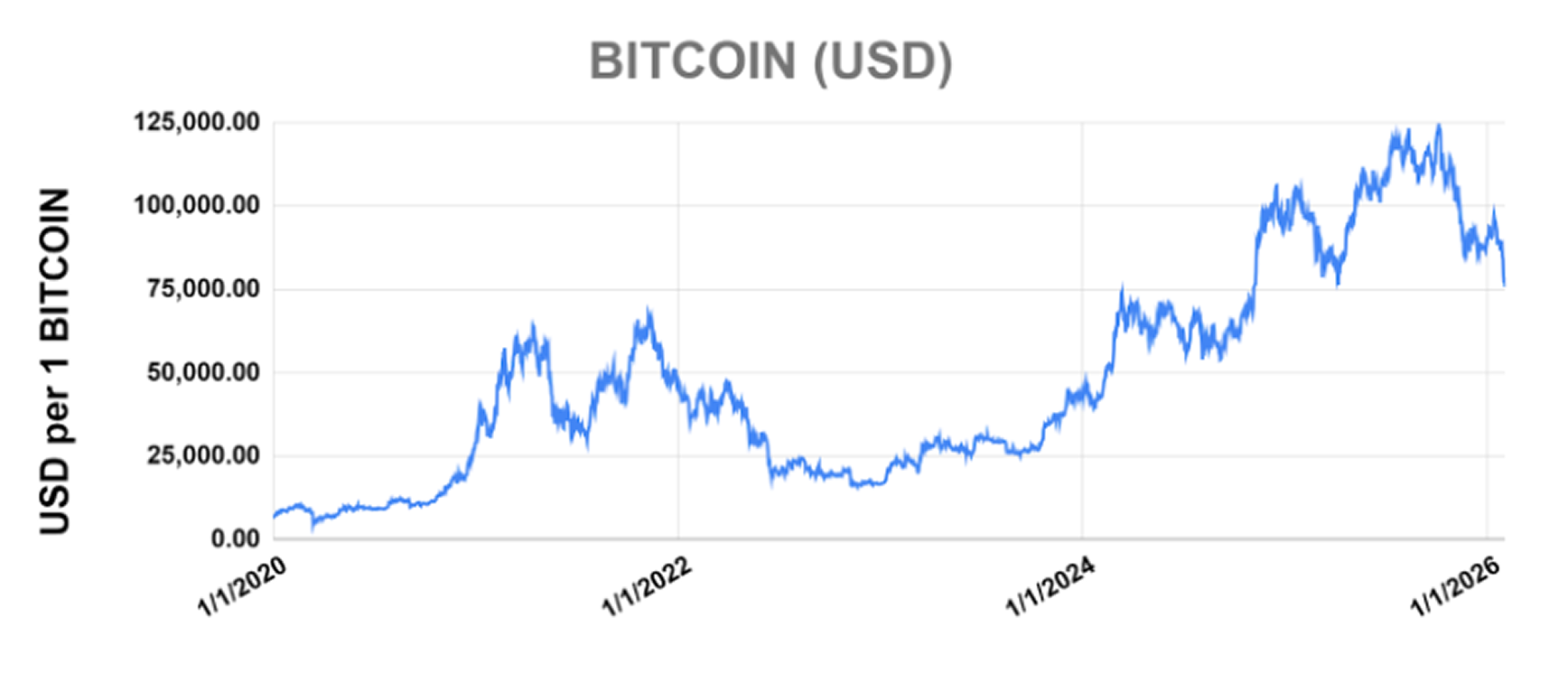
But where is it now?
What is Bitcoin again? And why do people care?
In case you’re wondering what Bitcoin is, it’s worthwhile to have a quick introduction or refresher. Bitcoin is one of the myriad number of so-called “cryptocurrencies” (“crypto”), a group of digital currencies or means of exchange that includes the likes of Ethereum, DOGECoin and Solana.
Bitcoin is perhaps the most well-known, as it was the first crypto (invented in 2008, first used in 2009), and is currently the most widely used. The fact that it is decentralized - that is, free of government control - and is backed by secure (blockchain) technology, attracted many users.
The important thing to note about Bitcoin is that it’s a means of exchange. Similar to a country’s currency, people can buy or sell goods and services using bitcoin as the “currency” (wherever it’s accepted as a form of payment).
What drives the price of Bitcoin?
Much like a country’s currency, Bitcoin’s price is driven by supply and demand. The more demand there is, the higher the price, and vice versa.
Bitcoin itself has no intrinsic or fundamental value. It doesn’t exist in a physical form (unlike, say, a commodity like gold). It’s a virtual asset, with the ownership tracked by digital databases. A physical commodity like gold can be held in one’s hand, plus it has a multitude of uses within different industries (eg., jewellery, electronics). Bitcoin’s use is purely as a form of exchange.
From a fundamental viewpoint, Bitcoin doesn’t have any stream of future income (eg. dividends from a stock, or coupon interest from a bond). So one can’t even price or value Bitcoin using typical discounted cash flow methods. An individual country’s currency at least has the perceived health and stability (or otherwise) of the issuing country as fundamental reasons why it may rise or fall. Bitcoin, however, has no such entity to back its value.
So why did Bitcoin rally to its recent high?
Again, due to supply and demand. If one dives deeper into the demand side, one could argue that there was a fair amount of speculation involved. It’s the shiny new “asset” on the market, so to speak, and many investors (or specifically, speculators) wanted to jump on Bitcoin’s bandwagon.
A related issue that led to high demand and the associated price increase is, perhaps, “FOMO”, or essentially, the “Fear Of Missing Out”. People see that Bitcoin’s price is rising rapidly, and they buy Bitcoin because they don’t want to miss out on the opportunity. Which, of course, perpetuates the price rally even further.
When Donald Trump was elected to the US Presidency at the end of 2024, the expectation of fewer regulations for the crypto markets generated more positive sentiment going into 2025. This was compounded by Trump’s embrace of crypto (after earlier being against it), as evidenced by his own organization’s launch of “Trump coins” and other crypto-related business ventures.
The US government itself, under Trump’s executive order, is looking to set up the so-called “Strategic Bitcoin Reserve”, a Bitcoin version of the Strategic Petroleum Reserve. Essentially it would be an emergency stockpile of Bitcoin intended to mitigate future supply disruptions, much like the petroleum reserve’s objective. All these Trump-led initiatives may have led to continued positive momentum for Bitcoin during the first three quarters of 2025.
Why has Bitcoin dropped ~40% in the last few months?
The recent fall in Bitcoin’s price may be symptomatic of a general risk-off sentiment pervading markets during the last few months. Recent geopolitical manoeuvres like the capture of Venezuelan president Maduro and President Trump’s posturing about annexing Greenland has inflamed international tensions. On the economic front, the ongoing threat of Trump’s tariff policy has not eased uncertainty. And the economic data (eg., stagnant jobs growth in the US) doesn’t suggest that all is rosy
Future prospects for Bitcoin
Bitcoin, as the first and leading crypto, has established its place in the current economic and market environment. That is, Bitcoin (and crypto in general) is here to stay.
For those with long investment horizons, a small allocation may not significantly increase the portfolio’s volatility, but as outlined above, there's no fundamental reason why there should be a strategic holding of Bitcoin.
Over the shorter term, however, there are certainly opportunities to take advantage of its volatility. Such opportunities will be based more on momentum, sentiment or other behavioural factors, rather than on any fundamental underpinnings.